Curious where GTA home prices moved Recently? Here’s the local snapshot for Toronto, Richmond Hill, and Newmarket.
From boom-time euphoria in early 2022 to bust-time despair when prime rate soared to 5% at late 2023, 2026‘s real estate market is in the middle, a more a tired, watchful pause — buyers waiting for lower rates, further price drops, or clearer economic signals, while sellers wait for demand to return before listing. It’s a market of people holding their breath rather than one gripped by panic in either direction, with real financial pain concentrated in a visible minority rather than spread evenly across the population.
People are Curious to know where GTA home prices moved Recently? Here’s the local snapshot for Toronto, Richmond Hill, and Newmarket. An overview of both new-construction and resale housing conditions across these three markets, all part of the Toronto Regional Real Estate Board (TRREB) footprint and the Greater Toronto Area (GTA) new-home reporting region tracked by BILD/Altus Group.
New-home market : New construction across the GTA — including Newmarket, Richmond Hill, and Toronto — remains well below historical norms even as it recovers from 2025’s record lows. New home’s July figures put total new home sales at 1,018 units, a sharp rebound from the record low logged in July 2025, though still 40% under the decade average of 1,707 units for the month. The recovery has been uneven by product type: single-family homes — detached, linked, and semi-detached houses and townhouses — posted 781 sales in July, up significantly year-over-year and 50% above their 10-year average, while condo apartments moved just 237 units, up 40% from last year’s low but still 80% below the historical average. The benchmark price for a new condominium apartment was $1,054,938 in July, up 2.5% from a year earlier, while the benchmark price for a new single-family home was $1,362,433, down 8.5% year over year, reflecting an Ontario HST rebate that has disproportionately helped ground-oriented product qualify for relief.
City of Toronto:
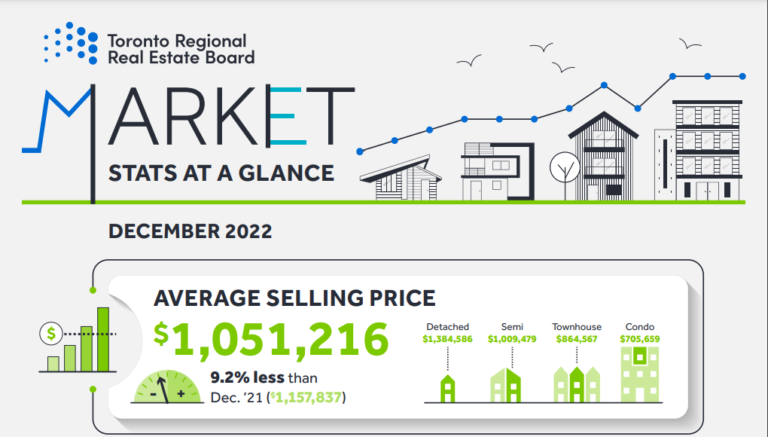
The resale market softened through summer 2026. GTA REALTORS reported 5,057 home sales in August 2026, down 2.1% compared to August 2025, with the MLS Home Price Index Composite benchmark down 4.5% year-over-year and the average selling price at $993,410, down 2.7%. The City of Toronto’s average home price specifically decreased 3.2% year-over-year to $1,010,836. By property type in August, the average detached home across the GTA sold for $1,288,669, semi-detached homes averaged $931,665, townhouses fell 8.6% to $786,817, and condos dropped 3.6% to $617,593 — condos being especially significant within Toronto proper given the city’s high-rise concentration.
On the new-build side, Toronto’s downtown and midtown condo towers represent the bulk of GTA high-rise inventory, and that segment remains the weakest link in the recovery, with builders holding back launches until absorption of existing unsold units improves.
City of Richmond Hill:
Resale activity here has been recovering in sales volume even as prices stay below year-ago levels. In June 2026, the Richmond Hill housing market recorded 230 home sales, up 2.7% from May 2026 and up 32.2% year-over-year, with an average selling price of $1,241,949 (median $1,104,000), up 2.7% month-over-month but down 4.1% year-over-year. Detached homes remain the dominant and priciest segment: 117 detached homes sold at an average of $1,685,722 (median $1,495,000), up 7.2% month-over-month but down 3.5% year-over-year, while condo apartments averaged $532,418, down 10.5% year-over-year. Inventory remains elevated relative to sales — 1,009 active listings and 5.7 months of inventory as of June, with a sales-to-new-listings ratio of 32.6% — signalling a market still favouring buyers, particularly for higher-end detached and luxury product.
New-home activity in Richmond Hill mirrors the broader York Region low-rise pattern, with limited condo launches but steadier townhouse and detached construction benefiting from HST relief.
City of Newmarket:
Newmarket’s resale market has shown similar buyer-friendly conditions with early signs of stabilizing prices. Newmarket’s median home price was $995,000 in August 2026, with 341 active listings and prices down 5.2% month-over-month; the Toronto Regional Real Estate Board’s composite benchmark price was $1.0 million, down 6.3% year-over-year, on 82 sales in July. Detached properties make up the largest share of the Newmarket market at 86% of active listings with an average price of $1.2 million. Earlier in the year the market showed a clearer buyer’s-market character, with 4.5 months of inventory, a sales-to-new-listings ratio around 34%, and days on market roughly doubling from 17 to 32 days year-over-year as of March 2026.
As a smaller, largely low-rise York Region municipality, Newmarket’s new-home supply is dominated by single-family and townhouse product rather than condos, positioning it to benefit disproportionately from the HST rebate’s focus on ground-oriented housing.
Overall comparison and outlook:
Toronto commands the highest overall average price (~$1.01M) but is weighed down by a soft condo segment; Richmond Hill sits highest among the two York Region cities (~$1.24M average, driven by detached homes) but shows the steepest year-over-year price declines from its 2025 peak; and Newmarket is the most moderately priced of the three (~$1.0M average/median) with signs of a price floor forming. Across all three markets, resale conditions remain buyer-favourable with elevated months of inventory and prices generally down 3–6% year-over-year, while new-home construction is recovering unevenly — low-rise and single-family product outperforming thanks to HST rebate eligibility, while condo/high-rise development, concentrated mostly in Toronto, continues to lag well behind historical sales averages. Less choice and more competition between buyers could ultimately result in renewed price growth in the months ahead if current inventory trends persist.